

A cold bedroom doesn’t always justify turning up the heat throughout your home. The best space heater for bedroom comfort should offer useful temperature control, manageable noise, and a design you can position safely. These six research-based picks cover different budgets and heating preferences, with clear trade-offs and running-cost examples to help you decide.
TopToHome may earn a commission when you buy through links on this page, at no extra cost to you.
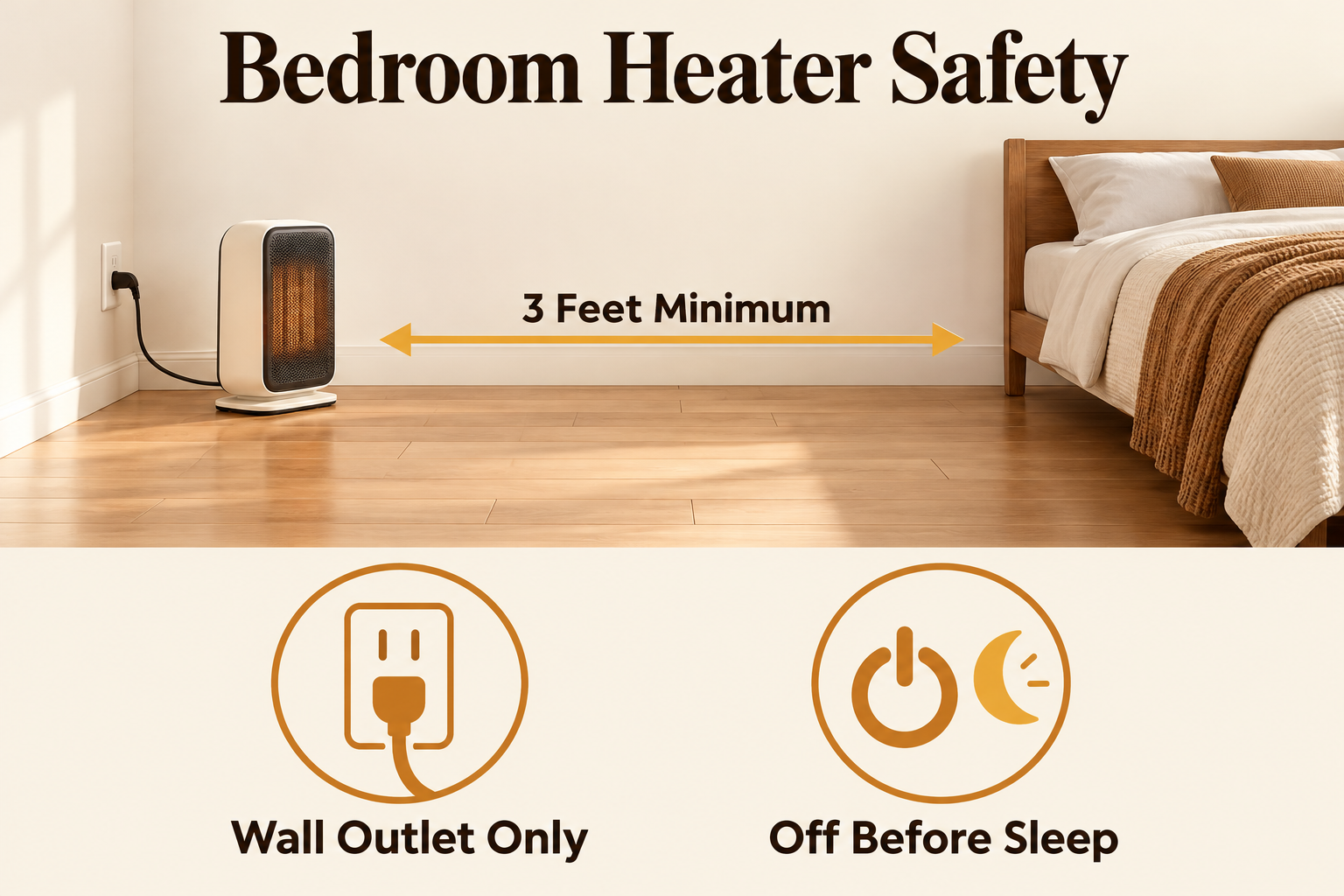
Bedroom safety comes first: Turn portable heaters off before sleeping. Keep them at least three feet from bedding, curtains, and furniture, and plug them directly into a wall outlet. A timer or tip-over switch does not replace these precautions. CPSC safety guidance
Quick Picks
- Best overall value: DREO Atom 316 — Useful digital controls and a remote without a premium price.
- Best basic budget option: BLACK+DECKER BHDC201 — Simple controls and two heat outputs, with fewer conveniences.
- Best premium fan-free option: De’Longhi Dragon Digital — Worth considering if avoiding fan noise matters more than portability.
- Best for oscillation: DREO Solaris Slim H3 — Sweeps warm air across a wider seating area.
- Best for straightforward controls: Vornado VH240 — A dial thermostat and whole-room circulation.
- Best for selectable heat settings: Honeywell HeatGenius HCE840B — Several heating configurations and a phased shutoff timer.
Bedroom Heater Comparison
Prices are approximate US shopping ranges observed during research, before shipping and tax. Seller, finish, and model variation affect the price.
| Product | Best for | Key specifications | Approximate price | Main advantage | Main drawback |
|---|---|---|---|---|---|
| DREO Atom 316 | Compact value | 1,500W maximum; digital thermostat; remote; timer | $35–$45 | Strong feature set for the price | Does not oscillate |
| BLACK+DECKER BHDC201 | Basic supplemental warmth | 750/1,500W; manual thermostat; fan-only mode | $20–$40 | Low purchase cost | No timer or remote |
| DREO Solaris Slim H3 | Spreading warm air | 1,500W maximum; 70° oscillation; remote; timer | $75–$85 | Adjustable airflow direction | Similar-looking variants complicate shopping |
| Vornado VH240 | Simple room heating | 1,500W maximum; three settings; dial thermostat | $60–$75 | Straightforward controls | No numerical temperature display |
| De’Longhi Dragon Digital TRD40615EBK-6A | Fan-free warmth | 1,500W; oil-filled radiator; digital controls | $180–$200 | No fan rushing sound | Heavy and relatively expensive |
| Honeywell HeatGenius HCE840B | Flexible heat settings | Six settings; digital controls; phased timer | $95–$105 | Multiple heating configurations | No remote control |
How We Chose These Heaters
We compared manufacturer specifications, manuals, warranty information, current sales listings, and available owner feedback. We have not physically tested these heaters, measured their noise, or timed their heating performance.
Our recommendations prioritize useful bedroom controls and practical differences. Manufacturer room-coverage and noise claims are not interchangeable laboratory measurements, and owner reviews cannot establish a product’s failure rate. Where reviews mix models or evidence is limited, we say so.
1. DREO Atom 316: Best Overall Value
Best for: Buyers who want a small bedroom heater with a thermostat, remote, and timer.
The Atom 316 combines a maximum 1,500W output with a digital thermostat adjustable from 41°F to 95°F. DREO also lists a 12-hour off timer, tip-over protection, and overheat protection. Its strongest selling point is getting those controls in a compact, relatively inexpensive package. Manufacturer specifications
Owner feedback repeatedly praises quick warmth, portability, and relatively quiet operation. Some feedback describes limited fan reach, and the fixed airflow means you may need to think carefully about placement rather than expecting oscillation to distribute warmth.
DREO’s published warranty policy provides 12 months of coverage, with an extension available through registration; confirm the terms for your seller. DREO warranty policy
Pros
- Digital temperature selection, remote, and timer.
- Compact design suits rooms with limited storage.
- Competitive purchase price.
Cons
- No oscillation.
- Still produces fan noise.
- Not a substitute for fixing a persistently drafty room.
Verdict: The Atom 316 is our starting recommendation for buyers who value controls and portability over sweeping airflow.
[AFFILIATE LINK]
2. BLACK+DECKER BHDC201: Best Basic Budget Option
Best for: Buyers who want simple supplemental heat at a low upfront cost.
The BHDC201 offers 750W and 1,500W heat settings, a fan-only mode, and a manual adjustable thermostat. The manufacturer’s support page also confirms tip-over shutoff, overheat protection, and a six-foot cord. It weighs about 2.8 pounds. Product information
Positive owner comments focus on its small size and useful heat output. Negative feedback includes early failures, hot plugs, and reports of sparking. These are individual reports rather than verified failure statistics, but they deserve attention when comparing a low-cost heater. Owner feedback
BLACK+DECKER lists a one-year warranty. The lack of a timer and remote makes this a less convenient choice than the Atom when their prices are close. Manufacturer listing
Pros
- Low purchase cost.
- Simple physical controls.
- Lower 750W setting.
Cons
- No timer or remote.
- No displayed target temperature.
- Reliability and electrical complaints warrant caution.
Verdict: Consider it for occasional supervised use, but favor the Atom if the price difference is small.
[AFFILIATE LINK]
3. DREO Solaris Slim H3: Best for Oscillation
Best for: Bedrooms where you want warm airflow to sweep across an occupied area.
The Solaris Slim H3 adds 70° oscillation, a remote, and a 12-hour timer. Its digital thermostat adjusts from 41°F to 95°F, and maximum output is 1,500W. It offers more directional coverage than the fixed Atom without requiring a large tower. Manufacturer specifications
Owner comments praise warmth, portability, and convenient controls. The manufacturer’s review feed also contains remote-control complaints, although that feed includes different variants. Those reports are a reason to check your remote promptly, not proof of a widespread defect in every H3 version.
DREO sells standard and ALCI-plug versions. Match the exact product to the listing and manual rather than assuming every H3 has identical features. The published base warranty is 12 months, with registration extensions subject to terms.
Pros
- Oscillation spreads airflow.
- Numerical thermostat and remote.
- Smaller footprint than many tall heaters.
Cons
- Costs more than the Atom.
- Variant names can be confusing.
- Oscillation does not increase maximum heating power.
Verdict: Pay extra for the H3 when moving airflow solves a specific comfort problem in your room.
[AFFILIATE LINK]
4. Vornado VH240: Best for Straightforward Controls
Best for: Buyers who prefer a thermostat dial over a digital menu.
The VH240 uses Vornado’s circulating airflow design, three heat settings, and a mechanical thermostat. It includes tip-over and overheat protection, with a five-year warranty. Vornado identifies it as the updated option for the discontinued VH200. Manufacturer listing
Some VH240 owners praise room warmth and quiet operation. However, the available feedback is smaller than for older Vornado heaters, and some reviews are incentivized. We would not transfer the VH200’s testing results or long-term reputation directly to this model. VH240 owner feedback
The main compromise is temperature selection. You adjust a dial for comfort instead of choosing a displayed setting such as 68°F. That can be pleasantly simple or frustrating, depending on how you use the room.
Pros
- Simple controls.
- Whole-room airflow approach.
- Five-year warranty.
Cons
- No numerical temperature display.
- No remote.
- Limited model-specific long-term evidence.
Verdict: Choose the VH240 for simplicity and warranty coverage, rather than precise digital control.
[AFFILIATE LINK]
5. De’Longhi Dragon Digital: Best Premium Fan-Free Option
Best for: People who dislike fan noise and can accommodate a heavier radiator.
The Dragon Digital TRD40615EBK-6A is a 1,500W oil-filled radiator with electronic controls and an ECO function. Because it has no fan, it avoids the continuous rushing sound of a fan heater. Fan-free does not mean completely silent: operating and expansion sounds remain possible. Manufacturer listing
At roughly 26 pounds, it is substantially less convenient to carry than the compact models here. Its oil-filled construction also suits buyers who value gradual warmth more than an immediate directed blast.
Exact-model owner evidence is limited; reviews of earlier Dragon versions should not be treated as confirmation of this version’s reliability. De’Longhi’s published warranty information is inconsistent. [VERIFY: Confirm written warranty coverage for TRD40615EBK-6A before publishing.]
Pros
- No fan rushing sound.
- Digital controls.
- Wheels help with repositioning on suitable floors.
Cons
- High upfront cost.
- Heavy.
- Warranty requires clarification.
Verdict: Consider the Dragon for fan-free comfort, not an assumption that oil-filled heat costs less to produce.
[AFFILIATE LINK]
6. Honeywell HeatGenius HCE840B: Best for Selectable Heat Settings
Best for: Buyers who want several heating configurations for different seated activities.
The HeatGenius offers six settings, including personal, room, floor, and quiet-mode options. Its HeatPhase timer reduces heat in stages before shutting down. Honeywell lists a three-year limited warranty. Manufacturer information
Owner feedback praises effective warmth and readable controls. Quiet mode still uses a fan, and it should not be confused with silent operation. There is no remote, which makes the DREO options more convenient for adjustments from across a room. Sales listing and owner feedback
Consumer Reports found that its exhaust outlet could become hot enough to cause a burn. Keep it away from curious children and pets, and do not interpret cool-touch housing as a promise that every surface stays cool. Independent testing
Pros
- Several useful heating settings.
- Gradual shutoff option.
- Three-year limited warranty.
Cons
- No remote.
- Exhaust outlet can become hot.
- Stock varies between retailers.
Verdict: Choose it for selectable heat settings, rather than the lowest price or smallest footprint.
[AFFILIATE LINK]
How to Choose the Best Space Heater for Bedroom Use
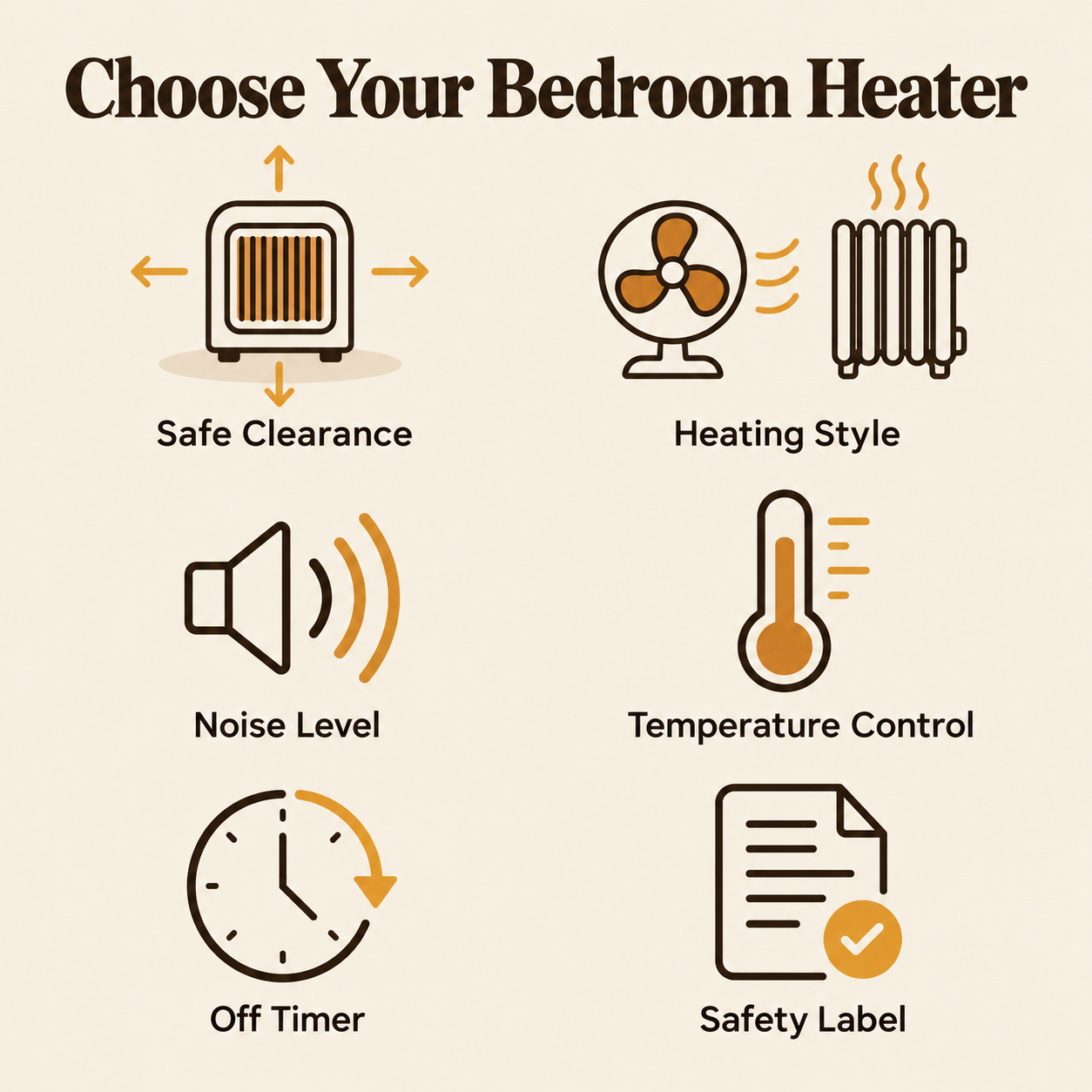
1. Start with safe floor space
Measure the usable space after allowing the required clearance from bedding, curtains, and furniture. A small heater still needs a clear operating area. If its cord cannot reach a suitable wall outlet without crossing a walkway, choose another position or heating solution.
2. Match the heating style to your routine
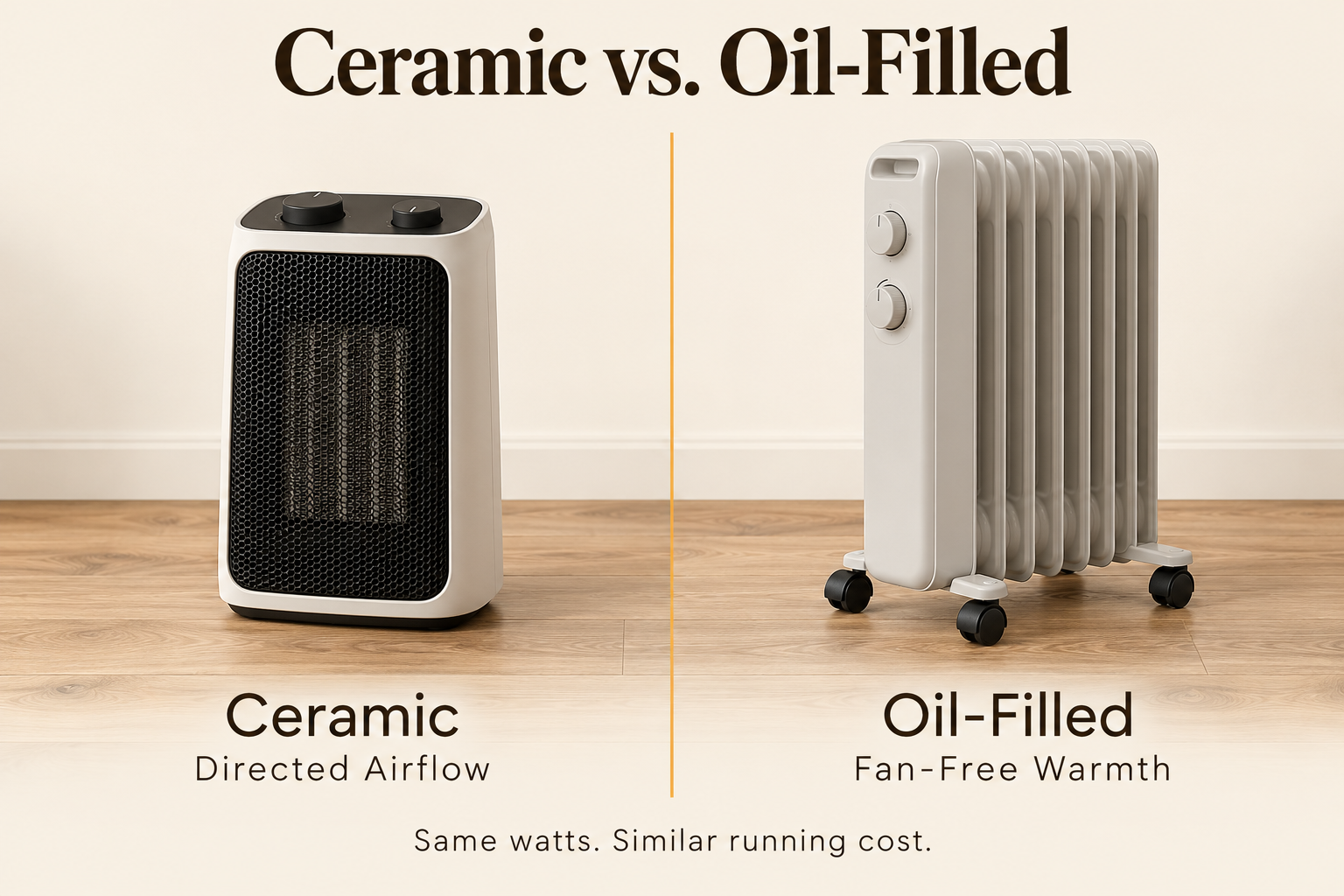
Ceramic fan heaters provide directed warm airflow and suit short periods of reading or getting dressed. Oil-filled radiators provide fan-free warmth but are heavier and less immediate. Neither design guarantees lower electricity consumption for the same heat delivered.
3. Look beyond the advertised decibel figure
Noise claims may use different distances, settings, and measurement conditions. Consider fan pitch, cycling clicks, button beeps, and oscillation sounds as well. Buy from a seller with a practical return policy if sound sensitivity is your main concern.
4. Choose controls you will actually use
A bedroom heater with a thermostat helps limit overheating. Numerical settings make adjustments easier to repeat, but the displayed temperature may differ from conditions near your chair. A remote is useful when the safest heater position is across the room.
5. Treat timers as backup convenience
An off timer can limit an unnecessarily long session. It does not make unattended operation appropriate or override the instruction to switch off before sleeping. Prefer controls that make the heater’s operating state clear at a glance.
6. Check the exact model and safety label
Confirm the model number, manual, tip-over protection, overheat protection, and recognized third-party safety listing before buying. [VERIFY: Confirm current certification marks for each linked model.] Similar names and shared review pages can conceal meaningful differences.
Will a Bedroom Space Heater Lower Your Heating Bill?
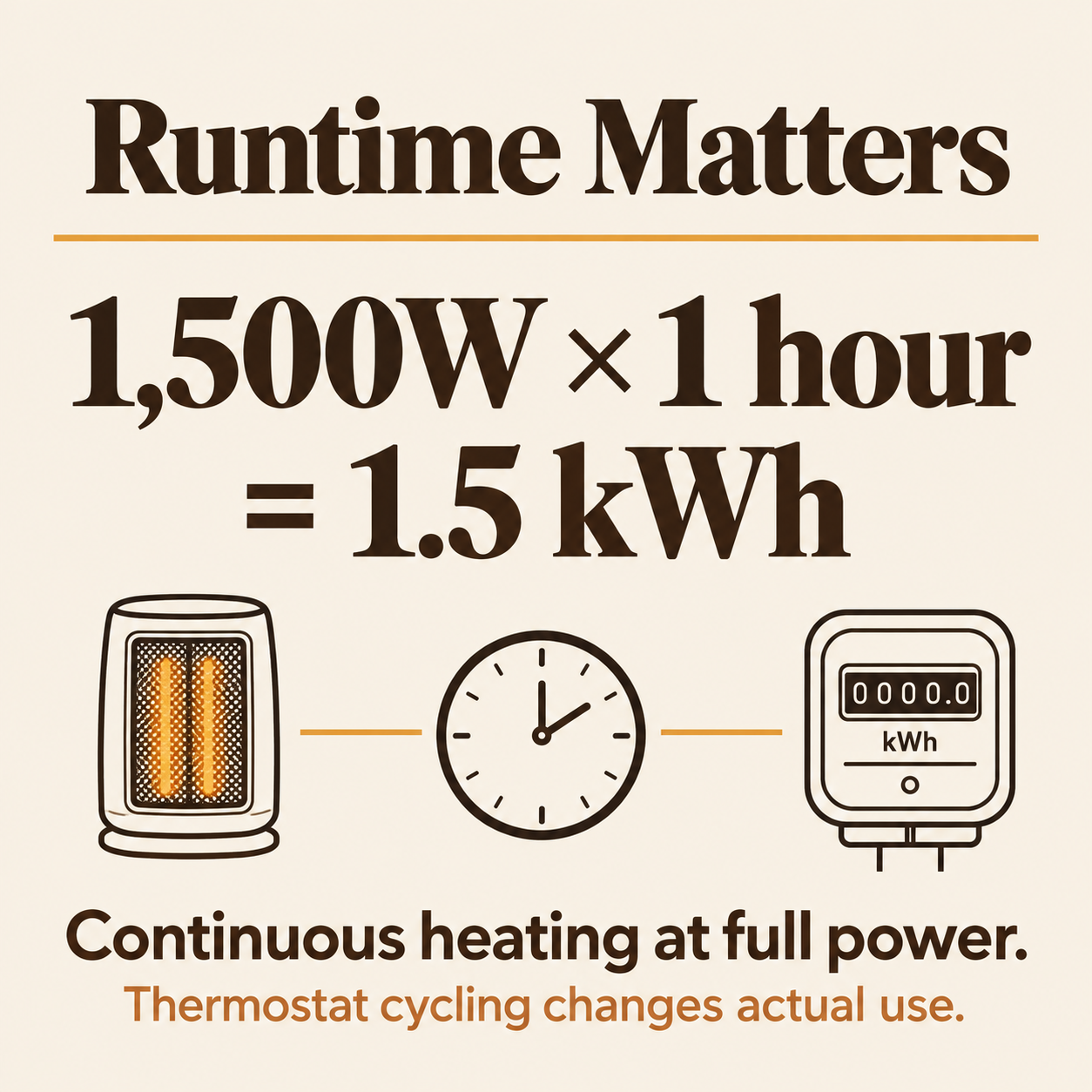
It can help when you genuinely reduce other heating enough to offset its electricity use. Adding a heater while leaving the main heating unchanged adds another expense.
Electric resistance heaters turn electricity into heat at broadly similar point-of-use efficiency. ECO settings can reduce output or runtime, but they do not make 1,500W of electricity produce unlimited warmth. Electric-heater efficiency explained
Calculate the operating cost this way:
Watts ÷ 1,000 × hours actively heating × electricity price per kWh
At an illustrative $0.20/kWh:
| Continuous output | One hour | Two hours daily for 30 days |
|---|---|---|
| 750W | $0.15 | $9 |
| 1,000W | $0.20 | $12 |
| 1,500W | $0.30 | $18 |
These examples exclude the purchase price and assume continuous heating. Thermostat cycling changes actual consumption. Use your own electricity rate, including applicable usage-based charges.
A lower setting draws less power while active but may run longer to deliver the heat your room needs. Likewise, an oil-filled radiator’s stored warmth is not free energy; it came from electricity consumed earlier.
If you already use a heat pump, supplemental resistance heating may be a poor money-saving strategy. Heat pumps transfer heat rather than generating it through resistance, so they can deliver comparable warmth using less electricity. Department of Energy guidance
Why We Excluded Govee Heaters
CPSC recalled Govee and GoveeLife models H7130, H7131, H7132, H7133, H7134, and H7135, including the H7130101 variation, because of fire and burn hazards. We do not recommend those models. Owners should follow the official stop-use and refund instructions. Govee recall notice
Frequently Asked Questions
Is it safe to sleep with a bedroom space heater running?
CPSC advises turning portable heaters off while sleeping. Tip-over protection, thermostats, and timers reduce certain risks but do not replace that guidance. Warm the room while you are awake, keep the required clearance from bedding and curtains, and switch the heater off before going to sleep.
What is the quietest type of bedroom heater?
An oil-filled radiator avoids fan noise, making it worth considering if continuous airflow sound bothers you. It can still produce clicks or expansion sounds. Fan heaters vary by setting and design, and advertised decibel figures are difficult to compare unless they were measured under the same conditions.
How much does a 1,500W space heater cost to run?
A heater continuously drawing 1,500W uses 1.5 kilowatt-hours each hour. At an illustrative electricity rate of $0.20 per kWh, that costs $0.30 per hour. Your bill depends on your local rate, selected output, operating time, and how often the thermostat stops the heating element.
Is a ceramic or oil-filled heater cheaper to run?
At the same electrical input and runtime, their electricity costs are essentially the same. The practical differences are heat delivery, fan noise, warm-up behavior, and controls. A thermostat may reduce operating time, but an oil-filled design does not automatically make equivalent heat cheaper than a ceramic heater.
Does a space heater’s ECO mode really save electricity?
ECO mode can save electricity by lowering output or stopping heating once the thermostat reaches its target. Savings depend on room conditions, temperature settings, and the alternative operating mode. There is no universal percentage saving, and selecting ECO does not guarantee that your overall household heating bill will fall.
Can a small heater warm a large or drafty bedroom?
Possibly, but cabinet size and advertised coverage do not tell the whole story. Insulation, outdoor temperature, ceiling height, and air leakage affect heating demand. Two heaters with the same maximum wattage have similar electrical input limits. Addressing drafts may improve comfort more than buying a larger-looking heater.
Final Verdict
Start with the DREO Atom 316 for compact value and useful controls. Choose the Solaris Slim H3 if oscillation matters, or the De’Longhi Dragon Digital if avoiding fan noise justifies the extra cost and weight.
For lower heating bills, focus on runtime, your electricity rate, and the heat you actually replace. The right heater improves comfort; it cannot guarantee savings.
Save This Bedroom Heater Guide
Editorial Checklist — Remove Before Publishing
- [VERIFY] Confirm written De’Longhi warranty coverage for TRD40615EBK-6A.
- [VERIFY] Confirm current safety certification labels for every exact linked model.
- [VERIFY] Match DREO standard/ALCI and Vornado VH240/VH240+ variants carefully.
- [VERIFY] Recheck current prices and stock at every affiliate destination.
- [VERIFY] Honeywell documentation contains inconsistent maximum-wattage figures; no exact wattage is stated for it in this draft.
- Replace all six [AFFILIATE LINK] placeholders with verified product links. Intended tracking ID: toptohome0b4-20.
- Add licensed product images and a featured image with safe bedroom placement. No images have been attached.
- Add relevant internal links after the destination articles exist: bedroom window drafts, ceramic versus oil-filled heaters, electricity-cost calculation, and space heater safety.
- Configure FAQ structured data through the site’s SEO plugin without duplicating schema.
- Focus keyword: best space heater for bedroom.
- Suggested secondary keywords: quiet space heater for bedroom; small bedroom heater; bedroom heater with thermostat; ceramic vs oil-filled heater; space heater electricity cost; energy-efficient bedroom heater.
